
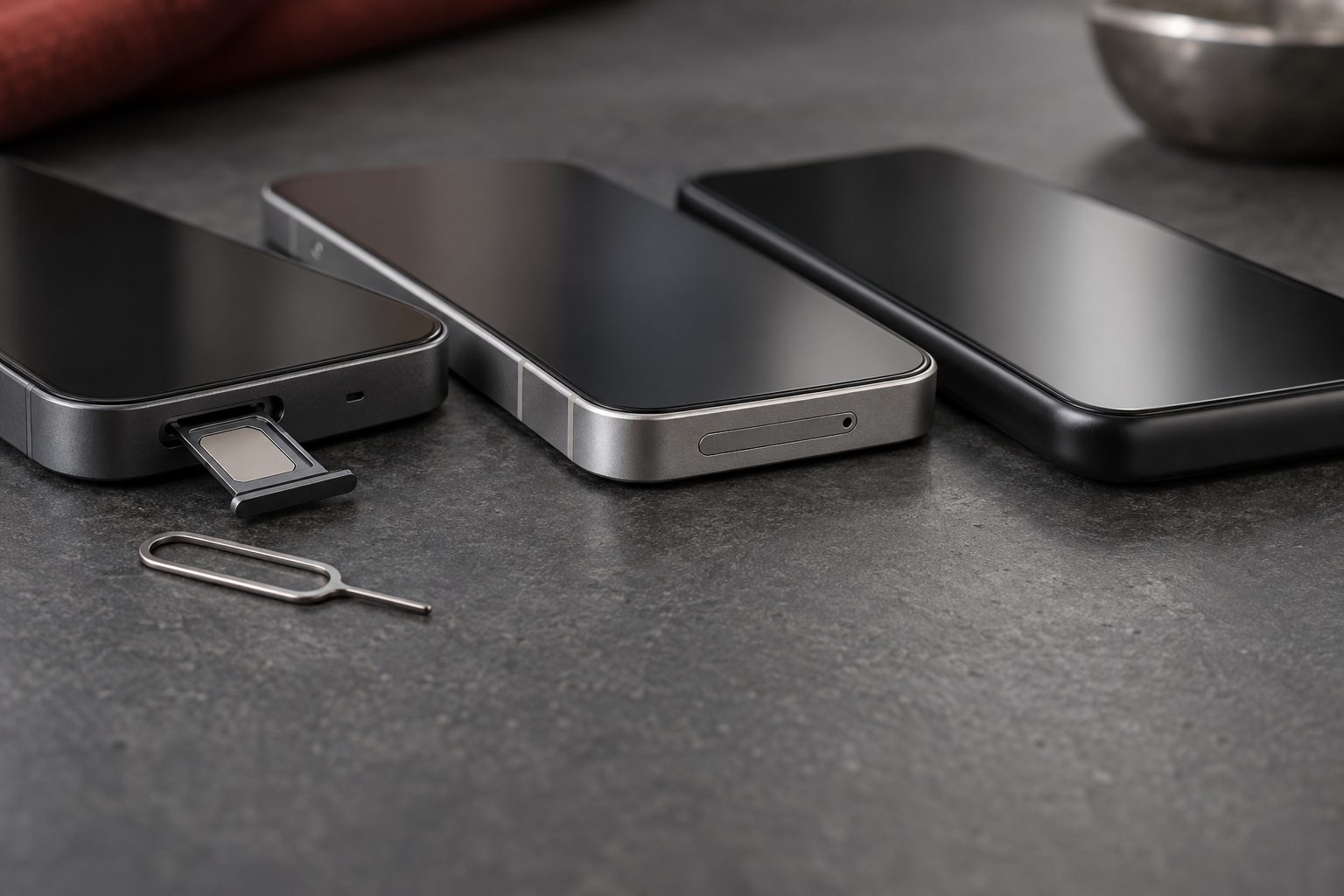
An iPhone sold for another market may have a different SIM configuration. Before buying one for Peru, check its A#### model number, carrier compatibility and whether its IMEI is on OSIPTEL's white list. A phone bought abroad is registered with your carrier, and one that is not on the white list may get a warning and be at risk of being blocked. iPhone 14, 15 and 16 models sold in the United States have no SIM tray and accept only eSIM.
How to tell which region an iPhone is from
Go to Settings > General > About > Model Number. The screen first shows the part number; tap it to see the A#### model number Apple uses to identify a hardware variant. Compare both numbers with the box when they appear there and check Apple's official specifications for that model. The A#### number alone does not establish where the device was bought; ask the seller for that in writing.
Knowing the region does not tell you the device is genuine. That is in how to tell if it is genuine or a clone.
American iPhone, eSIM only
According to Apple's page on SIM type, these models are eSIM only, with no physical tray.
- iPhone 14, 15 and 16 (including Plus, Pro, Pro Max and 16e) bought in the United States.
- iPhone Air, iPhone 17, 17e, 17 Pro and 17 Pro Max, and iPhone 18 Pro and 18 Pro Max bought in the markets Apple lists for eSIM-only variants. Check the country of purchase and exact model on Apple's official page.
Peru is not among those eSIM-only markets on Apple's page. For models bought outside them, Apple says eSIM and nano-SIM. A refurbished American iPhone with no tray is not defective or a clone merely because it has no tray, but you need a carrier to activate an eSIM. We did not check which Peruvian carriers activate eSIM, on what terms or at what price, so ask yours before buying an eSIM-only iPhone.
Locked to a carrier
A listing that says "locked" describes a device that accepts the SIM of only one carrier. We did not find a page explaining how to ask a Peruvian carrier for an unlock, or what happens with an American phone that still owes a balance to its original carrier. To test it, put in an active SIM from another carrier and confirm it registers on the network and can make a call. Do not confuse that lock with OSIPTEL's block, which works by IMEI and is explained in how to check an IMEI.
A phone bought abroad: registration
According to OSIPTEL, if you brought a phone from abroad after 22 April 2024, you must go to your carrier and ask for it to be registered on the white list. Phones already in service before that date were added automatically. A device that is not on the list may get a warning and, if it is not regularised, be blocked. We could not confirm what documents each carrier asks for or how long it takes. Also, the MTC says every device that enters the country must be homologated. The detail is in how to check an IMEI.
Chinese-ROM Android
Software and bands can vary by model and market. Ask for the exact model number and check the manufacturer's official specifications for the Google services you need and the bands your carrier uses. Do not infer compatibility solely from a listing's "China version" label.
Samsung, Snapdragon or Exynos
Ask for the exact model number of the listed Galaxy and check its specifications on Samsung's official page for that model and market. We did not confirm with Samsung which processor each variant offered in Peru uses.
The bands that matter in Peru
There is no public list of models with the bands each carrier accepts, so compare the bands the maker publishes for your model with your carrier's. This is what we could confirm about the carriers, from a 2019 OSIPTEL working paper and each carrier's own pages, which may have changed.
- Claro. 4G on band 2 (1900 MHz), according to its September 2016 release, and on band 28 (700 MHz), according to its February 2017 release.
- Movistar. 4G on bands 2, 4 (AWS) and 28 (700 MHz), according to OSIPTEL and the MTC. Movistar's page mentions the AWS frequency.
- Entel. 4G on bands 2, 4 (AWS) and 28 (700 MHz), according to OSIPTEL and the MTC.
- Bitel. 4G on band 8 (900 MHz), according to its own page, and on band 2, where OSIPTEL lists Viettel among the operators with 4G on 1900 MHz.
These bands allow a first 4G compatibility check, but do not prove coverage or service for a particular device: Claro, 2 or 28. Movistar, 2, 4 or 28. Entel, 2, 4 or 28. Bitel, 2 or 8. We could not confirm band 7 for Claro that appears on a forum, or other bands for Entel and Movistar. Bitel says its 3G is on 1900 and 900 MHz, we found no shutdown date for any 3G network or a source for 2G, and we did not research virtual operators.
For 5G, the MTC signed 3.5 GHz (band n78) concession contracts with Bitel, Claro, Entel and Integratel (Movistar) on 12 February 2026. We only verified live 5G in the zones Movistar advertises. A 5G phone can use 4G if it supports the carrier's bands. Confirm coverage, plan and compatibility with your carrier, and try your SIM in the device before you decide.
MTC homologation
According to the MTC, every device that enters the country must be homologated to operate normally. Phones, tablets and smartwatches that are imported or bought online need the MTC homologation certificate, with a letter from the manufacturer about the cell broadcast system and a TAC that matches the GSMA database. We could not open the MTC's lookup by brand and model from a script, so we give no list of homologated models. We did not confirm whether a used phone resold inside Peru needs its own certificate. The Checa tu IMEI lookup reports whether the IMEI is registered as stolen, lost or unblocked, and the page we read does not describe model homologation.
Before you pay
- Ask for the full model number and compare it with the box and with Settings.
- If it is an iPhone 14 or later from the United States, confirm with your carrier that it will activate an eSIM for you.
- If it says "locked" or "one carrier only", ask whether it is paid off and which carrier locks it, and do not expect an unlock without proof.
- If the device comes from abroad, ask whether it is already on the white list and who registered it.
- If it is an Android for another market, check Google services and bands in that model's official specifications.
- Check the IMEI in Checa tu IMEI.
With the device in your hand, follow what to check when it arrives. The detail on your rights and the warranty terms is in your rights when buying refurbished.
Sources
- Apple, SIM card type of your iPhone or iPad
- Apple, how to find the model number
- Samsung Peru, Galaxy S models
- OSIPTEL, white list and RENTESEG, FAQ
- OSIPTEL, Checa tu IMEI
- OSIPTEL, press note of 14 April 2026 on the blocking of phones
- MTC, everything you need to know about phone homologation
- MTC, new conditions for importing phones
- OSIPTEL, state of the radio spectrum in Peru (working paper, 2019)
- MTC, 4G-LTE enablement
- MTC, 4G antenna expansion and 5G contracts (12 February 2026)
- Claro, press release of 26 September 2016
- Claro, press release of 2 February 2017
- Movistar Peru, 4G LTE
- Movistar Peru, 5G phones
- Bitel, plans
- Ley 29571, Consumer Protection and Defence Code, INDECOPI edition (March 2023)
- INDECOPI, how to file a complaint
The 4G bands for each carrier come from a 2019 OSIPTEL document and from carrier pages of different dates, and may have changed. Claro band 7, 5G service for Claro, Entel and Bitel, and the Samsung chip sold in Peru are not confirmed. None of this replaces advice from a Peruvian lawyer.